
Cousins Explained
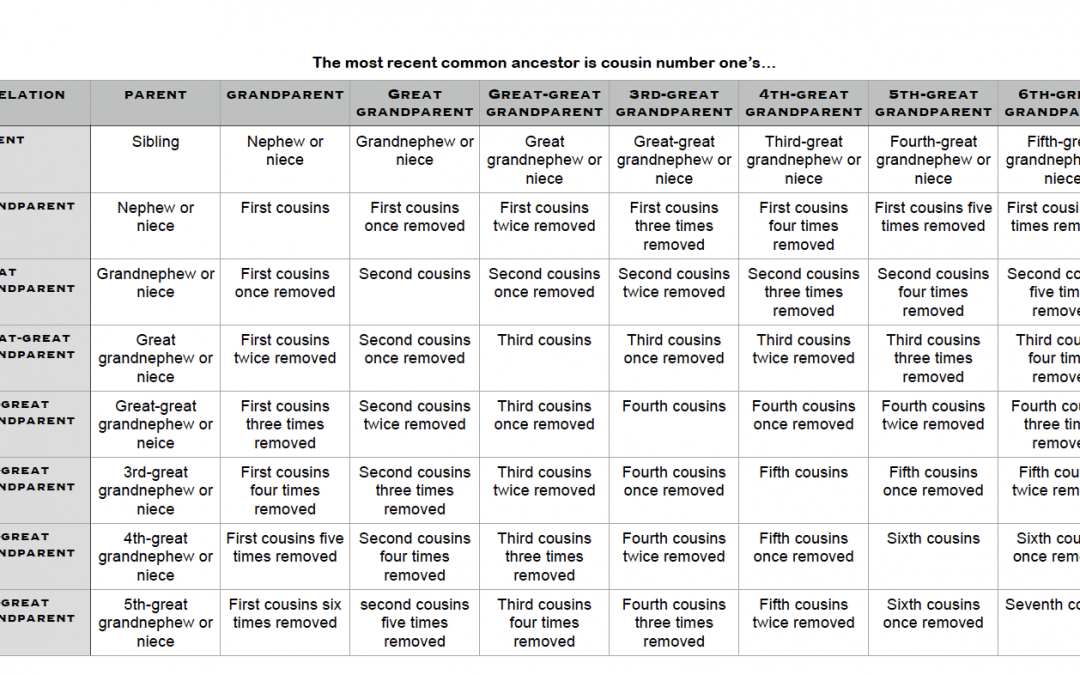
How to use the Cousin Chart Download
First, identify the most recent common ancestor for the two relatives in question. Then find each relative’s relationship to that ancestor on the sides of the chart. Where the row and column meet, you’ll find their relationship.

What is a second cousin once removed?
If you’re puzzled over the expression “second cousin once removed” or “twice removed,” you’re not alone. Luckily, the answer is simple: All cousins share a common ancestor. Your “degree of cousinhood” (second, third, fourth) depends on how many generations back that common ancestor is. Knowing this, you can make your own cousin’s calculator.
Take your first cousins, who you know are your aunts’ and uncles’ children. You all have the same grandparents. Your second cousins share a set of great-grandparents with you, your third cousins have the same great-great-grandparents, and so on. So your granddaughter and your sister’s grandson would be second cousins, for example—they have two generations between them and the common ancestor (your parents).
When it comes to cousinhood, the relationship possibilities are endless. The number of grandparents doubles with each generation. Count back 10 generations, and that’s 2,046 total ancestors, which means the cousin potential is exponential. You could have millions of them: fourth cousins, second cousins three times removed, tenth cousins twice removed. And with DNA testing, Facebook, online family trees, and message boards that connect you to new cousins every day, you’re bound to get curious about exactly how you’re related. Good thing we’re here with this guide on figuring out what kind of cousins you are, based on degrees of separation from shared ancestors.
Collateral Degree Calculation
Anthropologists call the process of figuring out cousin relationships “collateral degree calculation”. Multiple removes and degrees of cousinhood can get complicated, but you don’t have to be a scientist to get it right. The chart below will help straighten out your ‘cousin confusion’. For example, to figure out how you’re related to your great-great-grandmother’s sister’s son, first determine the ancestor you share with him: your third-great-grandmother. Find her on the chart, then count down one generation for the sister and one more for the sister’s son. He’s your first cousin three times removed.

What are Cousins?
Your cousins are people with whom you share a common ancestor, and the most recent common ancestor you share is at least two generations away. That distinguishes them from, say, your siblings, who are the people with whom you share common ancestors that are one generation away—those common ancestors are your parents.
What makes someone your cousin?
The simple fact that you share an ancestor with that person. But to understand the intricacies of cousin relationships, you have to get this: Your ancestors are only the people in your direct line: parents, grandparents, great-grandparents and so on. Your ancestors’ siblings are aunts and uncles (no matter how many greats you add)—not ancestors. Just about any other blood relative who isn’t your sibling, ancestor, aunt or uncle is your cousin. To determine your degree of cousinhood—first, second, third, fourth—you need to identify the ancestor you share with your cousin, and how many generations separate each of you from that ancestor.
First cousins
Your first cousins are the children of your aunts and uncles. First cousins share a grandparent (i.e., your grandparents are two generations away from both you and your first cousins). Your first cousin (sometimes called a full cousin, but usually just a cousin) is the child of your aunt or uncle. The most recent ancestor you and your first cousin share is your grandparent. You typically share 12.5 percent of your first cousin’s DNA.
Second cousins
Second cousins share a great-grandparent and are the children of first cousins. So the kids of your dad’s first cousin are your second cousins. Your second cousins are the children of your parents’ first cousins. Take a look at your family tree, and you’ll see that you and your second cousins have the same great-grandparents. You typically share 3.125 percent of your second cousin’s DNA. For third cousins, great-great-grandparents are the most recent common ancestor and you share .781 percent of your DNA. You get the picture.
Third cousins
Third cousins share a great-great-grandparent and are the children of second cousins. The kids of your dad’s second cousin are your third cousins. Are you sensing a pattern here? Fourth cousins share a great-great-great-grandparent and so on.
Double Cousins
You may have heard people say they’re double cousins. That’s a special cousin category for the offspring of brothers- and sisters-in-law—for example, your sister weds your husband’s brother. Instead of sharing one set of grandparents, as first cousins do, double cousins share both sets of grandparents. As you might expect, double cousins have more DNA in common than typical first cousins—about 25 percent.
“Kissing” Cousins
Despite how it sounds, a kissing cousin isn’t a cousin you marry. Rather, it’s any distant relative you know well enough to kiss hello at family gatherings. Now we’re begging the question: How close a cousin is too close to marry? States have different laws governing consanguineous marriages (and we’ve heard all the jokes, so just stop right now). It’s best to ask a lawyer about statutes for the state in question. And while we’re on the topic: Due to limited mobility in our ancestors’ day, most of us have instances in our family trees of cousins who married, whether knowingly or unknowingly. That means you can be related to the same person in multiple ways.
Someone you’re related to by marriage, rather than by blood, isn’t your cousin. You might be in-laws, or your relationship might not have a name other than (we hope) good friends.
Tip: Remember that the shared DNA numbers we give are averages. Due to the random way DNA is inherited, it’s possible you don’t share any DNA with a given relative beyond second cousins.

Removing Cousins
“Removes” enter the picture when two relatives don’t have the same number of generations between them and their most recent common ancestor. One generation difference equals one remove.
Let’s go back to the previous example—say your granddaughter has a son. He has three generations between him and the common ancestor (your parents), but your sister’s grandson still has only two generations in-between.
So they would be second cousins, but once removed. Likewise, your grandparents’ cousins are your first cousins twice removed because of the two-generation difference from you to your grandparents. Your great-great-grandparents are still the common ancestor.
What does “removed” cousin mean?
A remove happens when two cousins have different numbers of generations back to their most recent common ancestor. One generation of difference equals one remove. First, count back the number of generations from each cousin to the common ancestor. The cousin with the lower number of generations determines the degree of cousinhood—first, second, third and so on. Then subtract the lower number of generations from the higher number to find out how many times removed the cousins are.
Once removed
If you’re “removed” from a cousin, that means you’re from different generations. If you’re “once removed” from a cousin, that means you are separated by one generation. Your dad’s first cousin is your first cousin, once removed. Your first cousin’s daughter is also your first cousin, once removed.
Twice removed
If you’re “twice removed” from a cousin, you are separated by two generations. Your grandmother’s first cousin is your first cousin, twice removed. The granddaughter of your first cousin is also your first cousin, twice removed.
4 Steps to Identify a Cousin Relationship
Most Recent Acestor
First, Identify the most recent shared ancestor.

Determine Each Relationship
Find the level
“Equalize” the cousins at the level of the one closest to the common ancestor.

Figure out Distance
Add one “removed” for each difference in generations between them. Each “removal” signifies one generation of difference between the two. Your first cousin’s child is your first cousin once removed. Your first cousin’s grandchild is your first cousin twice removed.